


The Dreamwall Story
From a Warehouse in Wallonia to the Forefront of Virtual Production: The Dreamwall Story
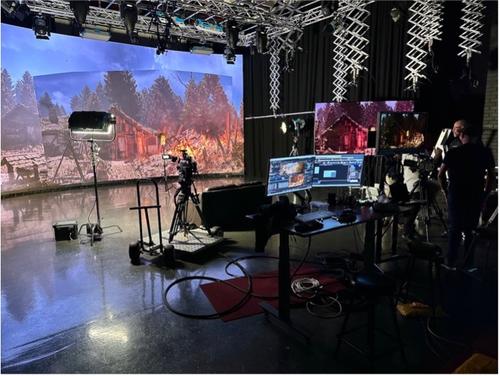
In Marcinelle, a district of Charleroi in the heart of Belgium's Wallonia region, a studio has established itself as one of Europe's most technically accomplished Virtual Production facilities.
Dreamwall's Media & Digital Broadcast division spans the full range of what modern broadcast production demands: virtual set design and live augmented reality, motion design and broadcast branding, daily programme production, accessibility services, and studio rental. Its client list reaches from Belgian public broadcaster RTBF to France Télévisions, the European Parliament, and beyond.
Dreamwall is neither a dedicated post-production house nor solely a facilities provider, but rather a production partner to its clients, capable of owning the entire pipeline. As the team explains, Dreamwall offers broadcasters "a complete production chain, from graphic set design to final broadcasting."
Animated Outlook
Dreamwall's origins are not rooted solely in live broadcasting or Virtual Production. The studio was founded in 2007 as an animation production company with the ambition to relaunch the Belgian animation industry, as Managing Director Thibault Baras explains. "At the end of the '80s, all animated production had gone to Asia due to cost. The idea behind Dreamwall was to relaunch the production machine, after 25 years of absence from the Belgian market."
With no established pool of animators in Belgium to draw from, an assembled Dreamwall team taught itself, project by project, building capability through practice for almost half a decade, working on bigger and bigger productions.
In 2014 Dreamwall delivered smash hit Asterix: The Mansions of the Gods. They would go on to receive great acclaim for follow-up projects, including Best Animated Film awards and nominations at the César Awards for Wolfy, the Incredible Secret and Zombillenium. However, as early as 2010, Dreamwall’s ambitions had already expanded beyond their initial specialisation in animation, moving into studio hire and broadcast services, leveraging the team’s versatile skillsets to inform their approach.
A New Horizon
Weather broadcasting might seem an unlikely platform for technological ambition, but it turned out to be exactly the right one. Daily, repeatable, operationally demanding, and watched by millions.
Dreamwall's production relationship with RTBF grew into an operation of striking scale. Today, the company’s dedicated weather studio produces up to twenty bulletins per day for La Une, TV5 Monde, and several regional television channels – running continuously, 365 days a year.
The project that truly defined this chapter was launched in March 2013. “Quel Temps?”, a daily programme broadcast on La Une, before the flagship 1 p.m. news. The original concept was driven by Jean-Charles Beaubois, the programme's first presenter and head of RTBF's Weather Department at the time – a weather broadcast segment that would engage viewers as well as inform them.
By November 2023, the programme had surpassed 2,000 episodes and made the transition from pre-records to live broadcasting two hundred times per year – a significant shift in the production model, but one that would empower the team to deliver programming with real-time reactions to weather events, remote guests via video link, and special editions responding to breaking news such as the devastating Belgian floods experienced that summer.
Constantly Evolving
The evolution of Dreamwall's Virtual Production infrastructure was driven by the constant pressure of live broadcast requirements and shaped by a deliberate investment in both technology partnerships and internal talent.
Central to the studio's technical capability was its adoption of Epic Games’ Unreal Engine for its real-time broadcast workflow, leveraging the company’s years of experience building, lighting, texturing, and animating virtual environments within an animation context.
The virtual set of the revamped and rebranded ‘Quel Temps pour La Planete?’ (QTLP) has undergone repeated transformations across its years on air: 3D representations of the Earth, augmented reality weather tools, environments that can shift instantly from the Belgian coastline to the Ardennes forests. This development has been based on continuous co-creation, iterating constantly in collaboration with their clients’ broadcast teams throughout a project's life. As Executive Producer Manuel Testa attests, "Our strength lies in our expertise. Our teams, tools, and methodologies continuously evolve to meet increasingly complex challenges."
The breadth of work that has come through the Marcinelle studios reflects the versatility this approach enables. Dreamwall's motion design credits include World Cup studio branding for Qatari broadcaster Alkass, the graphic package for Drag Race Belgium, and the Euro 2024 studio set design. Election night coverage for RTBF, France Télévisions, RTL, and the European Parliament represents another major strand, requiring live data connections, real-time results display, and broadcast infrastructure management at the highest level of reliability.
MoRail: Ahead of the Curve
One of the most recent milestones in Dreamwall's production history came on 10 November 2025, when QTLP went to air live for the first time in its newest format. This was not simply a technical upgrade. It was a fundamental reimagining of what a daily weather and climate programme could be, and at the centre of this was a new level of immersion delivered with camera movement that could take full advantage of Dreamwall’s virtual sets.
In the run-up to the broadcast, Dreamwall worked in close collaboration with RTBF's editorial teams and its own graphics, virtual production and planning specialists to design an environment that could deliver in a live context without compromising on the visual quality the show that it had built its reputation on. The challenge, as RTBF's Hugues Lanneau describes it, was to be reactive, to address community concerns, and to bring citizens closer to climate issues – "all without losing the momentum of the story."
Mo-Sys's camera rail system was identified as a key tool in meeting this challenge. MoRail delivers the controlled, precise movement, enabling camera choreography that feels dynamic and purposeful on screen rather than constrained.
The six-metre curved rail travels in a ninety-degree arc around Dreamwall’s greenscreen studio, allowing the camera to orbit around the presenter, revealing the depth and dimension of the virtual set with smooth elegant movement – all while maintaining the focus on the talent and their message.
The impact on the programme was immediate and tangible. RTBF presenter François Boueyrie explains not only the production benefits of the motorised rail system, but also the support MoRail provides for presenters: "The rail system follows us and creates movement. It's great for viewers, but also for us as presenters. We only need to move slightly, and the camera does the rest."
StarTracker: An Eye on the Sky
In a live Virtual Production environment, camera movement is not simply a stylistic choice, but a technical event. Every move must be tracked with precision and communicated to the rendering engine in real time, so that the virtual environment responds correctly and the physical and digital worlds remain visually unified.
For a studio producing twenty weather bulletins a day across seven cameras, with zero tolerance for failure, tracking accuracy is not a technical nicety – it is the foundation that everything else is built on.
Mo-Sys StarTracker has become the industry standard for demanding live broadcast environments. Using a randomly placed constellation of retro-reflective markers mounted to the studio ceiling, StarTracker provides sub-millimetre positional accuracy with latency low enough to remain imperceptible on-air.
With a workflow requiring continuous synchronisation between real-world camera positions and Unreal Engine for reliable 24/7 operation, Mo-Sys’ fully integrated ecosystem of hardware and software presented an obvious choice for Dreamwall. They opted to combine the MoRail system with StarTracker Max tracking, to seamlessly glue the dynamic real-world camera moves of the MoRail with the virtual set.
The Forecast
The live broadcast of the newly upgraded QTLP in November 2025 was a beginning, not an endpoint. Dreamwall has multiple new initiatives that are already in development, including the exploration of gaussian splatting and scanning techniques to bring real-world locations into the studio.
By enabling smooth, precise, synchronised camera movement within a live virtual production pipeline, the combination of MoRail and StarTracker has empowered Dreamwall to reliably deliver elegant moves for real-time transitions, genuine audience interactivity, and total graphical consistency between the physical set and the virtual elements surrounding it – day in, day out. They have set a new benchmark for what daily live broadcast in a virtual environment can achieve, and we can’t wait to see what the next iteration of the QTLP virtual set looks like!