


MoRail: Automated PTZ Camera Movement Without a Permanent Ceiling Track
by BM
MoRail is a freestanding motorised camera rail that adds automated physical movement to compatible PTZ and ENG camera workflows.
It coordinates rail position with pan, tilt, zoom, focus and iris control to create automated tracking, orbiting and parallax shots without permanently installing a ceiling-mounted camera track. It is designed for broadcast studios, newsrooms, virtual production, live events and sports environments.
For production teams using PTZ cameras, MoRail provides a practical way to add controlled physical movement while retaining centralised camera control. Its self-supporting design, height-adjustable motorised legs and integral energy-chain cable management support flexible set layouts and relocatable production environments. That combination is designed to make newsroom PTZ automation and studio space optimisation practical without requiring the structural commitment of automated ceiling camera track systems.
In brief: MoRail is suited to broadcasters and production teams that want automated camera movement but need more flexibility than a permanently installed ceiling track can provide.
Key takeaways
- MoRail adds physical camera motion to compatible PTZ and ENG workflows, enabling tracking, orbiting and parallax movement that a fixed-position PTZ cannot create on its own.
- One controller coordinates rail position with pan, tilt, zoom, focus and iris, helping operators repeat choreographed shots consistently.
- Unlike a permanently installed ceiling track, MoRail is freestanding and can be repositioned for changing studio layouts, shared facilities and temporary productions.
- Mechanical encoding supports graphics and virtual-production workflows that need camera movement data.
- MoRail can be used in newsrooms, broadcast studios, virtual production stages, corporate broadcasts, live events and stadium studio environments.
What is MoRail?
MoRail is a motorised camera rail system from Mo-Sys Solutions. Available in straight and curved configurations, it combines physical rail movement with camera control so production teams can automate a camera move rather than relying on a fixed PTZ position, manual dolly operation or separate control of the rail and camera head.
The system coordinates the rail’s position with camera pan, tilt, zoom, focus and iris functions. This makes it possible to programme and repeat moves such as presenter tracking, lateral reveals and curved orbiting shots. In compatible configurations, MoRail supports Sony, Canon, Panasonic and BirdDog PTZ systems directly, while ENG-camera workflows can use the Mo-Sys L20 remote head. MoRail product specification
A fixed-position PTZ can pan, tilt, zoom and reframe, but it cannot create true physical camera translation or lateral parallax without moving the camera itself. MoRail supplies that movement while retaining the operational advantages of a centrally controlled camera workflow.
How MoRail automates camera movement
MoRail combines three elements:
- A straight or curved motorised rail that moves the camera through physical space.
- A camera-control workflow that coordinates pan, tilt, zoom, focus and iris with rail movement.
- Positional data that can be used in compatible augmented-reality, virtual-set and camera-tracking workflows.
The result is a repeatable move that can be programmed for regular productions, including daily news bulletins, presentation formats and live-event segments. Rather than manually coordinating a rail move and camera framing every time, an operator can execute consistent movement at the touch of a button, from one programme to the next.
As Mo-Sys CEO Michael Geissler put it at the system’s launch, “Production teams can now benefit from accurate, repeatable PTZ movement, and beautifully smooth and immersive parallax movement, that helps even small news operations to create more immersive and engaging content.”
This approach does not remove the need for production planning or site-specific operational assessment. It does, however, avoid the permanent ceiling-track installation model used by restricted studio systems.
Why physical camera movement matters
Physical camera movement can change how viewers experience a scene. A 2023 Frontiers in Neuroscience study comparing static, handheld, dolly and Steadicam techniques found that moving-camera footage increased participants’ reported sense of involvement in the scene under the study’s test conditions. Yilma et al., 2023
A separate EEG study in PLOS ONE found stronger sensorimotor cortex activation while participants watched Steadicam footage than while watching static or zoomed footage of the same setting. The study examined a controlled viewing condition, so the findings should not be treated as a universal measure of audience attention. They do, however, support the production principle that camera movement can make a scene feel more embodied and immersive. PLOS ONE EEG study
For broadcasters, the practical implication is straightforward: controlled movement can add visual depth and a stronger sense of presence to presenter-led, interview, analysis and virtual-set shots. A fixed PTZ remains a cost-effective solution for many positions, while a motorised rail expands the shot vocabulary available from that workflow.
MoRail vs ceiling-mounted tracks
Automated ceiling camera track systems and freestanding camera rails can both automate camera movement, but they use different installation and operational models. The best option depends on the studio’s long-term layout, structural constraints, production schedule and need for relocation.
| Consideration | Ceiling-mounted camera track | Freestanding MoRail |
| Installation model | Installed into the studio’s overhead structure | Self-supporting motorised rail system |
| Structural planning | Typically requires structural, load and installation planning | Avoids permanent ceiling-track installation; site-specific safety and operational requirements still apply |
| Track path | Usually fixed once installed | Can be repositioned to support revised layouts or different productions |
| Set flexibility | Best suited to a stable, dedicated studio configuration | Well suited to shared studios, evolving sets and adaptable production spaces |
| Temporary productions | Less practical where permanent infrastructure is not appropriate | Can support temporary stages, event builds and productions in hired venues |
| Cable routing | Often integrated into fixed studio infrastructure | Integral energy-chain cable management within the rail system |
| Typical buying rationale | Long-term automated movement in a fixed studio | Automated movement with flexibility to reconfigure or relocate |
A ceiling system can be appropriate for a dedicated studio with a stable set design and a long-term infrastructure plan. A freestanding rail is often a better fit where studios are shared between productions, set layouts change frequently, or the equipment may need to move between facilities.
MoRail stands on motorised, height-adjustable legs and provides a 580 mm height-adjustment range. Its integral energy chain keeps cabling within the rail system rather than requiring permanent ceiling routing or unmanaged cables across the floor.
Applications for broadcast and production
Newsrooms and daily broadcast studios
Newsroom PTZ automation depends on repeatable shots that can run reliably across multiple bulletins while keeping crew requirements proportionate to the production. MoRail can automate presenter coverage, lateral moves and curved orbiting shots, creating a more dynamic presentation while retaining PTZ-style centralised operation.
DreamWall used a curved MoRail configuration with Mo-Sys tracking technology for RTBF’s Quel Temps pour la Planète? weather and climate programme. The installation was designed to create a moving camera perspective around the presenter while keeping the virtual environment aligned with the live camera movement. (Mo-Sys / DreamWall, 2026)
RTBF presenter François Boueyrie described the effect directly: “The rail system follows us and creates movement. It’s great for viewers, but also for us as presenters. We only need to move slightly, and the camera does the rest.” RTBF’s Hugues Lanneau framed the brief as needing to stay reactive and close to viewers “without losing the momentum of the story,” a demand a fixed PTZ shot cannot meet on its own.
Virtual production and AR graphics
When graphics, virtual set extensions or augmented-reality elements are layered over a moving camera shot, the rendering system needs reliable position information. Without accurate tracking and positional data, virtual elements can appear to slide relative to the real-world scene.
MoRail includes mechanical encoding for positional data. For more complex workflows, it can be used alongside Mo-Sys StarTracker camera tracking to help keep AR graphics, virtual set elements and sponsor overlays aligned with camera movement. Mo-Sys AR Graphics
For these more complex studio-tracking requirements, MoRail supplies the controlled physical movement, while StarTracker camera tracking supplies all the camera-position data required by the virtual-production pipeline.
Live events and corporate broadcasts
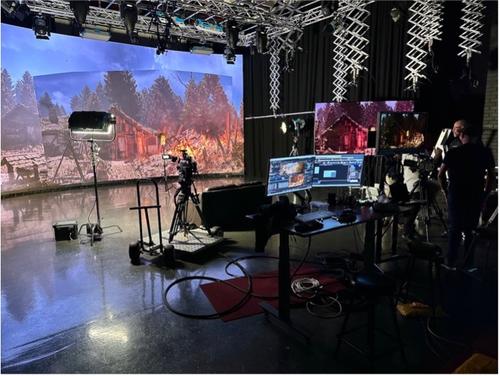
Temporary event stages, corporate presentation spaces, greenscreen studios and LED-volume builds may not allow permanent ceiling infrastructure. A freestanding rail can provide automated movement in these environments while allowing the production to remove or reposition the system after the event.
This can be useful for keynote stages, branded broadcasts, panel discussions and product launches where productions want smoother, repeatable camera motion without installing a fixed track in a venue they do not own.
Stadium and sports studios
MoRail can complement wider broadcast robotics workflows for stadium studios, mixed zones, analysis positions and sponsor-branded presentation areas. These are locations where a compact, centrally controlled PTZ or ENG-camera configuration may be practical, and controlled movement can add production value to walk-throughs, pre-match segments and half-time analysis.
Mo-Sys also provides robotics and remote-head systems, including RoboJib, U50 and L20, for other broadcast camera positions and movement requirements. Mo-Sys Sports Broadcast Solutions
Studio space optimisation
Studio space optimisation matters most where one floor supports multiple shows, teams or formats. Permanent infrastructure for automated ceiling camera track systems can be the right choice for long-term productions, but it can also restrict future set changes if the original installation no longer matches the operational requirement.
MoRail is designed to support a more adaptable model. Its freestanding configuration means that a production team can position the rail for a particular set, revise its placement after a redesign, or relocate it to another studio when required. This flexibility can be important for shared newsrooms, multi-purpose broadcast facilities, virtual production stages and temporary builds.
The operational benefit is not only spatial. By coordinating rail movement with pan, tilt, zoom, focus and iris control, MoRail can reduce the need to manually synchronise separate movement and framing tasks for repeatable shots. Crew requirements and operational workflows will always depend on the production, but centralised automation can make sophisticated camera moves more practical in smaller teams.
Choosing the right automation approach
When considering what type of automated camera motion system to adopt, it’s worth identifying whether your facility can afford to be tied down to the permanent configuration of a ceiling camera track system, or whether a freestanding rail such as MoRail can better serve your organisation’s needs. Freestanding systems are ideal when you need automated PTZ or ENG camera movement but also want to remain flexible, with the capability to adapt the set, work in a shared studio, support a temporary production, or relocate the automated camera rail system between facilities.
For a tailored workflow assessment, discuss your camera models, desired moves, studio dimensions, graphics requirements and operating model with the Mo-Sys team.
A fixed-position PTZ camera can pan, tilt and zoom, but it cannot create true physical parallax by itself because the camera does not translate through space. Mounting a compatible PTZ camera on a motorised rail allows the camera to move laterally or around a subject, creating changing foreground-background relationships.
Yes. Moving-camera AR and virtual-production workflows need reliable positional data to keep virtual elements aligned with the real-world shot. MoRail’s mechanical encoding can provide rail-position data, and compatible deployments can combine it with Mo-Sys StarTracker and the Encoder Kit for camera tracking and graphics workflows.
MoRail supports compatible Sony, Canon, Panasonic and BirdDog PTZ camera systems directly. ENG-camera workflows can use the Mo-Sys L20 remote head. Confirm compatibility, configuration and control requirements with Mo-Sys for a specific camera model and production workflow.
A freestanding rail can be a practical option for temporary studios, hired venues, event builds and changing set layouts because it does not require a permanent ceiling-track installation. Production teams should still assess floor conditions, available space, power, safety procedures and the specific configuration required for the venue.
A motorised camera rail is a system that moves a camera along a fixed or configurable path under powered control. In broadcast and production workflows, it can be used to create repeatable tracking, reveal and orbiting shots. MoRail is a freestanding motorised rail designed to automate physical movement alongside compatible camera controls.
All three can support camera movement, but they differ in how they are installed and operated. A traditional dolly track is commonly moved manually with a camera dolly. A ceiling camera track is permanently installed overhead. A motorised rail such as MoRail automates a camera move from a freestanding floor-supported system and can coordinate that movement with camera controls.
A ceiling-mounted track is installed permanently into a studio’s overhead structure. A freestanding rail such as MoRail supports automated movement from the floor and can be repositioned or relocated without installing a permanent ceiling track. The right choice depends on the facility’s structural plan, set stability and need for flexibility.